
[Yamanashi 100 Famous Mountains Challenge: 34th Peak - Mt. Kotaro] A panoramic view of the Northern Southern Alps All-Stars! To the best vantage point for the view [Mt. Kitadake/Mt. Kotaro, Part 2]
On the first day, after spending a night in a mountain hut, I climbed Mount Kitadake to see the Kitadake-sou flowers.
This time, we'll be hiking the Kotaro Ridge, which extends north from Kitadake, towards Kotaroyama, in the second part of our Kitadake/Kotaroyama trip.
Click here for Part 1 👇


Kotaro-yama is the northernmost peak of the Kotaro Ridge, which extends northward from Kitadake.
Because it's off the main ridge trail, it's a mountain visited by fewer hikers compared to Kitadake.
That's why it's a mountain that hunters aiming to conquer the 100 Famous Mountains of Yamanashi tend to leave unvisited.

Mount Kotaro is situated in an excellent location for overlooking the mountains of the northern part of the Southern Alps.
From here, you can see the northern all-stars of the Southern Alps: Mt. Kai-Komagatake to the north, Mt. Senjogatake to the west, Mt. Hououzan to the east, and Mt. Kitadake to the south.
This mountain truly offers a prime vantage point for viewing the Southern Alps.

However, the round trip from the Kotaroyama junction takes about 2 hours and 30 minutes.
This mountain is a bit of a time-consuming climb, even for a quick stop.
Also, compared to the main hiking trails on Mt. Kita, there are some parts where the path is unclear.
This might feel more challenging than a round trip to the summit of Mount Kita.

The first part ended with us climbing Mount Kita and returning to Katanokoya Hut.
The second part of this climbing report will cover the journey from Katanokoya Hut to Kotaroyama Mountain and the subsequent descent.
Finally, I've also compiled climbing information for Mt. Kitadake and Mt. Kotaroyama.
Please watch until the very end!
[Mountain Climbing Report]
To the best seats for viewing the South African Alps
Kitadake Kata-no-goya Hut - Kotaro-yama Junction - Kotaro-yama - Kotaro-yama Junction - Hirogawara

I took a photo with Chihiro Morimoto, the third-generation caretaker of Kitadake Kata-no-goya hut, who took such good care of me during this mountain trip.
The tenugui I have is a newly made original tenugui from Katanokoya.

To satisfy hungry hikers, Kitadake serves an enormous portion of rice at dinnertime, known as "Kitadake Mori."
This is an illustration that has been drawn on it.
I bought it because it brought back nostalgic memories and was so cute 😂


Now we'll head towards Mount Kotaro!
First, we'll retrace our steps from yesterday to the Kotaro-yama junction.

In stark contrast to yesterday's dense fog, Kotaro Ridge is bathed in clear skies! 👏
Further ahead in the direction of Mount Kotaro, you can get a good view of Mount Kai-Komagatake.

Mount Kai-Komagatake, as seen from Kofu and Hokuto City, is also very impressive.
Personally, I like the view of Mount Kai-Komagatake from the Kitadake side (south side).

In the first part, I wrote at length about the wonderfulness of Kotaro Ridge,
As expected, Kotaro Ridge, with its great views, is the best!

Enjoying the scenery and flowers as you walk, you'll arrive at the Kotaro-yama junction in no time.
The peak visible ahead on this ridge is Mount Kotaro, but it looks close
The main thing to be aware of about this mountain is that once you start climbing it, the trail is surprisingly long.
If you are heading to Mount Kotaro, be sure to allow plenty of time for your climb.

Now, let's take the ridge trail to Mount Kotaro, enjoying the scenery along the way!

The Kotaro-yama junction is at 2847m, and the summit of Kotaro-yama is at 2725m.
Although there are some ups and downs, the route is mostly downhill until you reach Mount Kotaro.
On the other hand, the return trip uphill is tough. 🙄

You can also hike while constantly having a view of Mount Senjōgatake, the queen of the Southern Alps.
I'll upload the Mount Senjōgatake episode in the next post.

There are some rocky sections, but generally, it's an easy ridge trail.

The rock jasmine blooms vigorously on the rocky cliffs; it's not a particularly rare flower.
I love the resilience of these flowers blooming on rocky slopes; they're one of the joys of early summer in the mountains.

Although I described it as an easy-to-follow ridge trail, there are still some unclear sections.
We had to weave through gaps in the dwarf pines, and there were winding paths with few footprints.
There are times when I'm unsure of what to do.

If the weather is as clear as it is today, head towards Mount Kotaro, which is visible.

You just need to go straight ahead.
When it's foggy and visibility is poor, be sure to look carefully for footprints and cairns as you proceed.

Looking back, I could now see the summit of Mount Kita-dake in the distance.
When viewed from the south (towards Mount Ainodake), Mount Kitadake presents a sharp, pointed peak.
When viewed from the north (towards Mount Kotaro), it appears as if it is twisting and narrowing towards the summit.
For a guy who loves Kotaro Ridge (like me), this is another reason why I recommend it (lol).

We're getting closer, and the peak with exposed rocks in the foreground is Mae-Kotaro-yama.
Someone climbing this mountain for the first time might easily mistake it for Mount Kotaro.
Even I, who have climbed it many times, made a mistake on the way there...
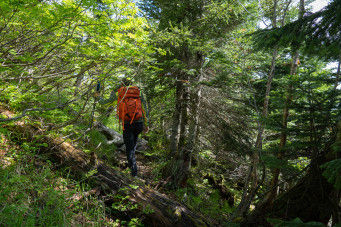
I've been walking along a ridge with great views all this time.
Unfortunately, just before reaching Mount Mae-Kotaro, you'll have to enter a wooded area.

After passing through the wooded area and the noisy section of dwarf pines, the view finally returns!
If you climb further from here

We've arrived at Mae-Kotaro-yama (2,700m)!
Now that we've reached Mae-Kotaro-yama, it's just a little further to Kotaro-yama! 💪

Mount Kotaro is now visible nearby! 🙌
Mist is rising from the east, but it looks like the weather will hold up until we reach the summit.
The clear blue sky remained beautiful until the very end, and not only that, but the combination of the blue sky and the green of the dwarf pines was stunning throughout.
Alright, let's go for the final climb! 🔥

We've arrived at Mt. Kotaro (2,725m)! 👏
While not as frequent as Mount Kita, this is another peak I've climbed many times while working at the mountain hut.
Compared to Mount Kita, there are fewer people here, and I can enjoy hiking in peace and quiet, making this one of my absolute favorite mountains.

From the clearing just below the summit, I take another look at Mount Kita.
The Kotaro Ridge curves beautifully, and of course, the view of Kitadake from Mount Kotaro is...
I personally believe this best captures the grandeur of this mountain.

To the north, you can clearly see Mount Kai-Komagatake and Mount Asayo.
Because it is lower and closer than when viewed from Kitadake, Asayo Peak appears much larger.

Looking west, I could see Mount Senjōgatake, which had been visible the whole time.
Here too, the cirque topography, which is characteristic of Mount Senjōgatake, is clearly visible.
The area between Kitadake and Kotaroyama is undoubtedly the best spot to view Senjōgatake.

On this day, we were unable to see Mt. Houou from Mt. Kotaro.
As shown in the photo above, the mountains of Fenghuang Mountain are visible to the east.
From there, you can also get a good view of the Hayakawa Ridge, which extends south to Asayo Peak.
The photo of Mt. Houou is taken from a field report from 5 years ago 👇


Mount Kotaro offers stunning views no matter which direction you look—east, west, north, or south.
Not only the view from the summit, but also the sense of accomplishment from leaving your footprints on the mountaintop.
It's a mountain where you can quietly savor the experience.
For Yamanashi 100 Famous Mountains hunters, and for all Southern Alps fans and climbers
This is definitely a mountain you should climb! 👍

When I returned to the Kotaro-yama junction, many hikers had already started walking towards Kitadake.
The gas started to rise again, but the forecast was for clear skies again the next morning.
Those who are climbing now will have been able to see a magnificent view the next day.

No matter how many times I visit Mount Kita, I'm always filled with a sense of reluctance to leave when I descend.
Even after visiting so many times, these feelings don't seem likely to change anytime soon.
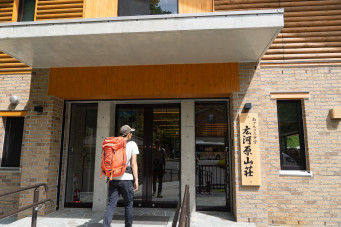
nevertheless

The lower world

I'm hurrying down the mountain for "this" 🍻
That concludes the second part of our trip to Mt. Kitadake/Mt. Kotaro!
Summary of hikes to Kitadake and Kotaroyama
[This mountain climbing report]
Hiking time: Day 1: 4 hours 54 minutes, Day 2: 9 hours 2 minutes
Distance: 15.1 km (total over 2 days)
Ascent: 2214m Descent: 2221m

*Quoted from the log of a companion.
[Standard course time (approximate): 13 hours 25 minutes]
Day 1: 5 hours 10 minutes
Hirogawara - 2:35 - Shirane-Oike Hut - 2:00 - Kotaro-yama Junction - 0:35 - Kitadake Shoulder Hut
Day 2: 8 hours 15 minutes
Kitadake Kata-no-Koya Hut - 0:40 - Kitadake - 0:20 - Tsurio-one Junction - 0:25 - Kitadake - 0:25 - Kitadake Kata-no-Koya Hut - 0:25 - Kotaro-yama Junction - 0:50 - Mae-Kotaro-yama - 0:20 - Kotaro-yama
Kotaro-yama - 1:30 - Kotaro-yama Junction - 1:30 - Shirane-Oike Hut - 1:50 - Hirogawara
[Access (Hirogawara)]
·car
Park your car at the municipal Ashiyasu parking lot and take a local bus or shared taxi.
The second parking lot is recommended as it is close to the taxi and bus stops.
·public transport
Take a local bus bound for "Hirogawara" from either Kofu Station or Ryuo Station.
*This is the timetable for the Hirogawara-Kofu bus route in 2023.
Dates and times may change in 2024. 👇

【advice】
Regarding the mountain climbing plan
A day trip to Mount Kita-dake is only feasible for those with strong legs, as the course time is approximately 10 hours.
In the main part of the climbing report, I didn't climb to the summit on the first day, but stayed overnight at Katanokoya hut and climbed the mountain on a later date.
Similarly, if you plan to climb Mt. Kotaro on the second day, it would be easier to climb Mt. Kitadake on the first day.
Besides Katanokoya Hut, there are three other mountain huts where you can stay overnight: Kitadake Sanso Hut and Shirane-Oike Hut.
You can choose a mountain hut based on your physical condition and the itinerary, but if you want to climb Mt. Ainodake on the second day, Kitadake Mountain Hut is a good choice, while those who are not confident in their climbing pace should choose Shiraneike Hut.
In any case, when hiking along the ridge of Mount Kitadake, it's best to choose the earliest possible time in the morning.
• About the snow/course
I think the information for 2024 will be accurately released by June, before the mountain opens.
Please check with each mountain hut or the city of Minami-Alps before making a decision.
The Ohkabazawa Left Branch course usually has snow remaining until late July, especially at the beginning of the climbing season.
Wearing crampons with front spikes is recommended.
If you're climbing in June or July during a year with a lot of lingering snow, it's safer to choose the grassy slope course.
Even the grassy slopes often have lingering snow in the early season, and light crampons may be necessary.
Until 2023, the Okabazawa course was closed, and no temporary toilets were installed at the Okabazawa fork.
For those concerned about toilets or supplies, the grassy slope course via Shirane-Oike Hut is definitely recommended.
・About the hiking trails
The route introduced here, Hirogawara - Kusasuberi Route - Kitadake, is well-maintained and has plenty of signs. Also, there are many hikers during the season, so you can climb with peace of mind.
However, the ridgeline is above 3000m in the treeline zone, so fatigue can easily accumulate, and the weather often changes suddenly.
Even when staying in a mountain hut, it's a good idea to aim for an early start and early arrival.
Also, although the route from the Kotaro-yama junction to Kotaro-yama has become easier to follow in recent years,
During severe weather, the route can easily become lost.
I recommend actively using maps, as well as GPS apps.
■ Check before going to this mountain
Mount Kotaro is a mountain for experienced climbers. For first-timers or those returning after a long break, proper equipment and clothing are crucial.
▶ List of essential equipment for your first mountain climb

▶ An Introduction to Hiking Clothing and Layering (Autumn/Winter Edition)

▶ Essential equipment for beginner hikers

■ Learn more about mountain climbing in Yamanashi
Yamanashi Prefecture has many mountains that can be enjoyed by beginners.
▶ Complete Guide to Mountain Climbing in Yamanashi

■ What you can do with ELK
At Elk, we provide support so that even beginner hikers can enjoy the mountains with peace of mind.
• Purchase of outdoor/mountaineering equipment
• Repair and maintenance of equipment
• Rental of mountaineering equipment
Accommodation and tour experiences
■Click here for Elk mountain climbing and hiking tours
▶ Click here for a list of services and store information.


Comments